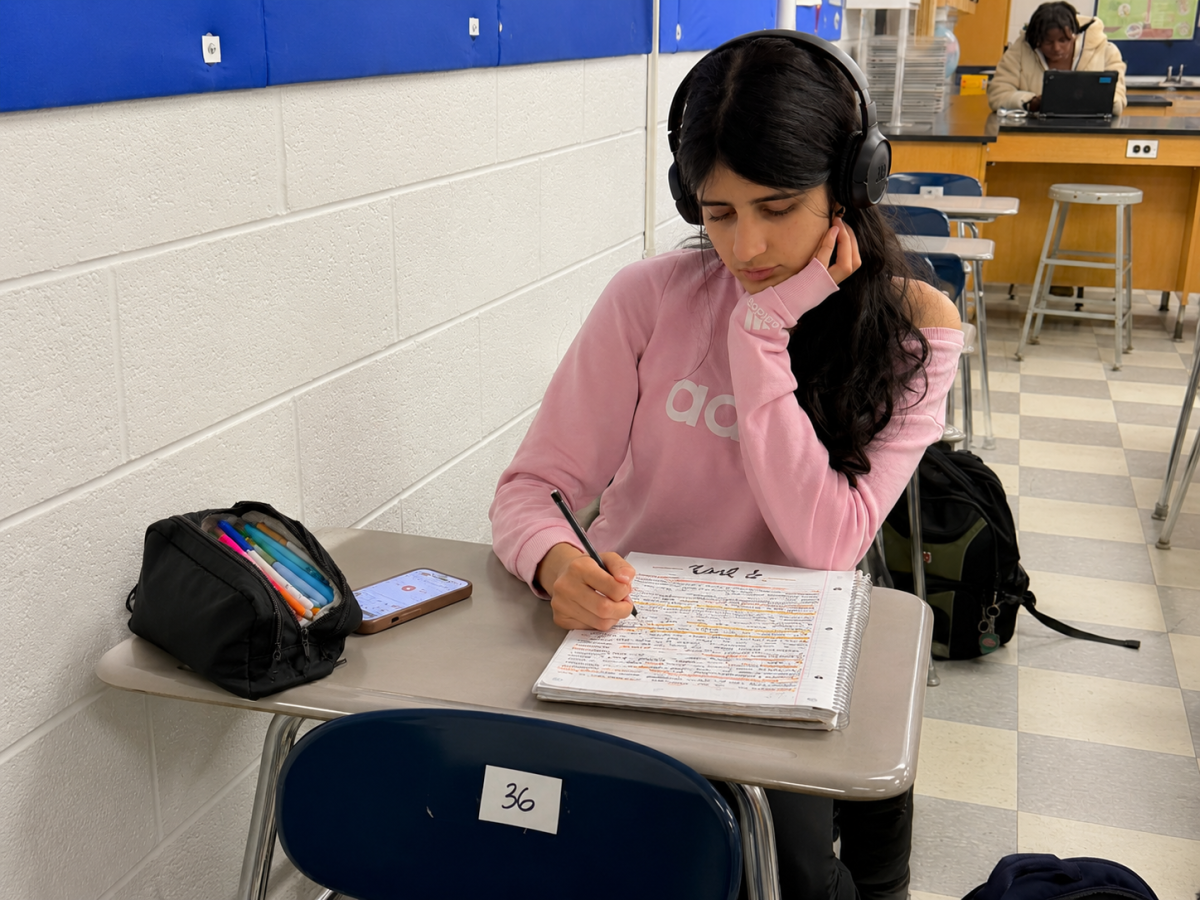
Students in Canton’s library are immersed in their work after school, moving between notes and deadlines as they try to stay focused, with headphones and background music blocking distractions and reducing stress.
“I focus more on the task at hand,” said Lakshita Rathi, Salem sophomore. “I put on headphones and listen to music without lyrics because I get distracted and start singing along, which does not allow me to fully focus on the task.”
As academic pressure builds throughout the school year, many P-CEP students use background music to help maintain focus. However, whether music improves concentration often depends on the type of music and the task being completed.
Research and student experience suggest that instrumental music may support concentration more effectively than lyrical music because it reduces distractions.
Rathi said she began using instrumental music during her freshman year after realizing lyrical music slowed her productivity. She later switched to instrumental playlists.
“It definitely allowed me to narrow my focus into one thing,” Rathi said.
She also said it helps reduce stress during long study sessions.“It’s definitely made me less stressed,” she said. “The music when I am stressed kind of recenters me.”
She added that she changes her study habits depending on the subject, avoiding music for math and memorization-heavy tasks, but using it for subjects like biology and psychology. “For memorization, definitely no music,” Rathi said. “Math is the type of subject where you have to talk yourself through it.”
Carolyn Costantino, Canton’s AP Psychology teacher, said that students often believe they can multitask, but the brain actually switches attention between tasks rather than processing them simultaneously.
“You cannot multitask,” Costantino said. “If you are listening to music and thinking about the lyrics, then you are not paying attention to what you should be focused on.”
A 2021 study by Luca Kiss and Karina J. Linnell found that certain types of music can improve attention during simple tasks by increasing motivation. In the study, researchers examined how different types of background music affected participants while completing cognitive tasks. However, the study also noted that music with lyrics can increase mental pressure during complex tasks like reading, since the brain processes language from both the music and tasks at the same time.
Similarly, a 2023 study by Ying Que et al., published in Scientific Reports, found that instrumental music is generally less distracting than lyrical music because it does not interfere with language comprehension. It also noted that silence is most effective for tasks requiring deep focus, such as memorization. Still, it is important to note that not all research agrees that silence is best for everyone.
Plymouth counselor Genovia Peterson said music is a common study aid among students, but its impact depends on the type of sound.
“With lyrics, students are more talkative and easily distracted because they are listening to the words instead of focusing on their work,” Peterson said.
She added that instrumental music can create a calmer, more focused environment, while lyrical music can increase distractions. However, she emphasized that study habits vary from student to student.
Additionally, a Harvard Medical School article by Allison Eck states that music affects parts of the brain involved in memory and stress regulation. It shows that listening to music can reduce stress by activating brain networks. Instrumental music is often less distracting than lyrical music because it does not compete with language processing. Together, these findings suggest that music choice can influence both concentration and stress levels.
Costantino said that instrumental music works better for the concentration of most students because it stays in the background instead of competing for attention. She further added that some students focus better with soft background noise because complete silence can make other distractions feel louder, and effectiveness depends on the individual and the task.

Aditi Bhagat, Salem senior, said she prefers lyrical music while doing homework and instrumental music or no music when she has to memorize information.
“When I have to memorize words, like [when using] flashcards, I don’t use music for that because it makes me lose focus,” she said.
Although students have different preferences, both research and interviews suggest that the effectiveness of music depends on the task, type of sound and the individual student. Lyrical music is more likely to interfere with reading and memorization, while instrumental music or silence is generally more effective for deep focus tasks.
As students continue to adjust their study habits, Rathi said the key is finding what works best for them personally rather than copying the habits of others.
“Everyone has their own unique habits and behaviors,” Rathi said. “Definitely altering your study habits to fit your own characteristics is very important rather than just going for whatever other people are doing.”