In an ever growing age of technology, AI is creating a new future for the coming generations. AI tools are influencing students’ academic performance and cognitive development, making it important to understand its pros and cons in academia.
In the case of Plymouth High School senior Amir Baig, AI became more than just a shortcut for homework.
“AI became like a coworker,” Baig said.
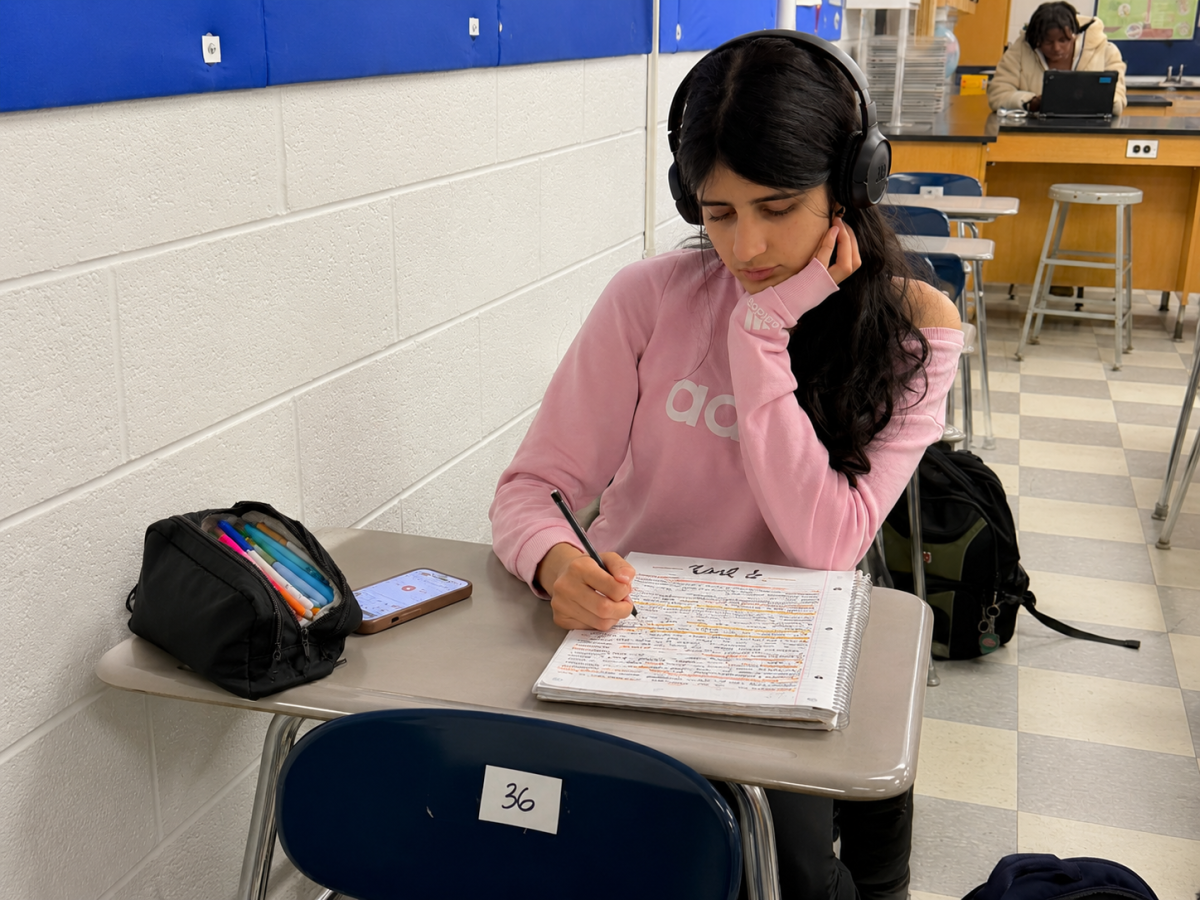
Baig views himself as a motivated student, challenging himself with advanced placement courses, dual enrollment, and demanding extracurriculars, while maintaining a 3.83 grade point average. And like many other students, Baig has begun to use AI chatbots such as ChatGPT to assist him in his coursework.
While some educators worry that AI is encouraging cheating or weakening critical thinking skills, Baig believes the technology has actually enhanced his learning experience in some of his classes.
“I was learning better from AI than I was from my teacher because it was tailored to my understanding,” Baig said.
The acceleration of AI use in schools has caused a significant shift in education. According to a study regarding AI in education from Pew Research Center, students around the world increasingly rely on AI for tutoring, brainstorming, writing assistance and test preparation. Researchers note AI can personalize learning and improve efficiency, but also caution that dependence can reduce their ability to think independently.
For Baig, AI became especially helpful in the face of heavy workloads, lessening the mental burden of his challenging classes.
“I uploaded all the materials into ChatGPT and said, ‘Teach this entire AP Chem unit to me like I’m a donkey,’” said Baig.
He explained that AI helped simplify concepts in ways that were easier for him to understand than through a traditional classroom style of instruction; however, Baig still acknowledged there is a difference between using AI to support learning and allowing it to take over assignments.
“If we treat AI like a human, the question is whether it’s helping you learn or doing the work for you,” Baig said.
Teachers and administrators throughout P-CCS are now trying to determine where that line should be drawn.
P-CCS Technology Integration Specialist Kaelyn Bullock said AI itself is not inherently harmful, but students and teachers must understand how to use it responsibly.
“Any tool can be used for good or for ill,” Bullock said. “AI can be a way to really personalize topics, help push thinking further for students and for teachers.”
Bullock said AI has the potential to improve education by giving students feedback and support; however, she also warned that misuse of the technology can negatively affect their learning in the long run.
“There’s lots that is exciting,” Bullock said. “We can see that there’s places for it, but there is a legitimate concern that there’s cognitive offloading going on. Students, teachers, humanity in general are getting lazier, and are going to lose some of the skills they need to have to function in society.”
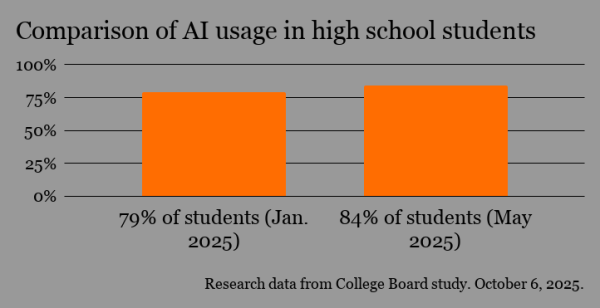
One growing concern among teachers is that students may begin overly relying on AI for coursework, stunting the development of their own writing and problem solving abilities.
English teacher Nicole Willett said she notices disparities between students who heavily misuse AI and those who an honest effort into her classwork.
“You can see the difference in students’ critical thinking ability, communication skills and verbal eloquence, when looking at those who are just skating by and those who are actually doing the work properly,” Willett said.
Willett also emphasized that students must carefully evaluate AI-generated information rather than automatically trusting it.
“Students need to use their critical thinking skills with AI and I am afraid they are not doing that,” Willett said.
The concern over academic honesty has also become more complicated as AI tools continue to advance, and teachers struggle to determine student authenticity.
Bullock referenced a phrase heard from another educator when discussing inappropriate AI usage: “Prompt and paste is pathetic.”
According to Bullock, simply copying AI-generated responses without understanding the material removes the learning process entirely. Yet, she makes clear that students should not fear AI itself.
“Don’t be afraid of it, learn more about it, be the human in the loop. You’re still in control,” Bullock said.
P-CCS Board of Education vice president Anupam Sidhu said the district is attempting to balance innovation with responsibility as AI increasingly becomes a part of education.
“We did not prohibit the use of AI, but we want to encourage the appropriate and ethical use,” Sidhu said.
Sidhu explained that AI is not something that can be realistically ignored in schools because it has already begun to take its place in jobs, and will continue to shape academia and future careers.
“It is a technology that is here and you can’t walk away from it and say, ‘No, it doesn’t exist,’” Sidhu said.
At the same time, Sidhu acknowledged concerns about inaccurate information, bias and reduced creativity among students.
“There’s a fine line in understanding what is really authentic and acceptable,” Sidhu said.
As AI continues to evolve, many students and educators agree that the technology itself is not necessarily the problem, and is undoubtedly here to stay. Instead, the real challenge may be determining whether AI use is strengthening learning, or replacing it entirely.
“The goal is to find a good balance where students understand its potential and limitations,” Sidhu said.