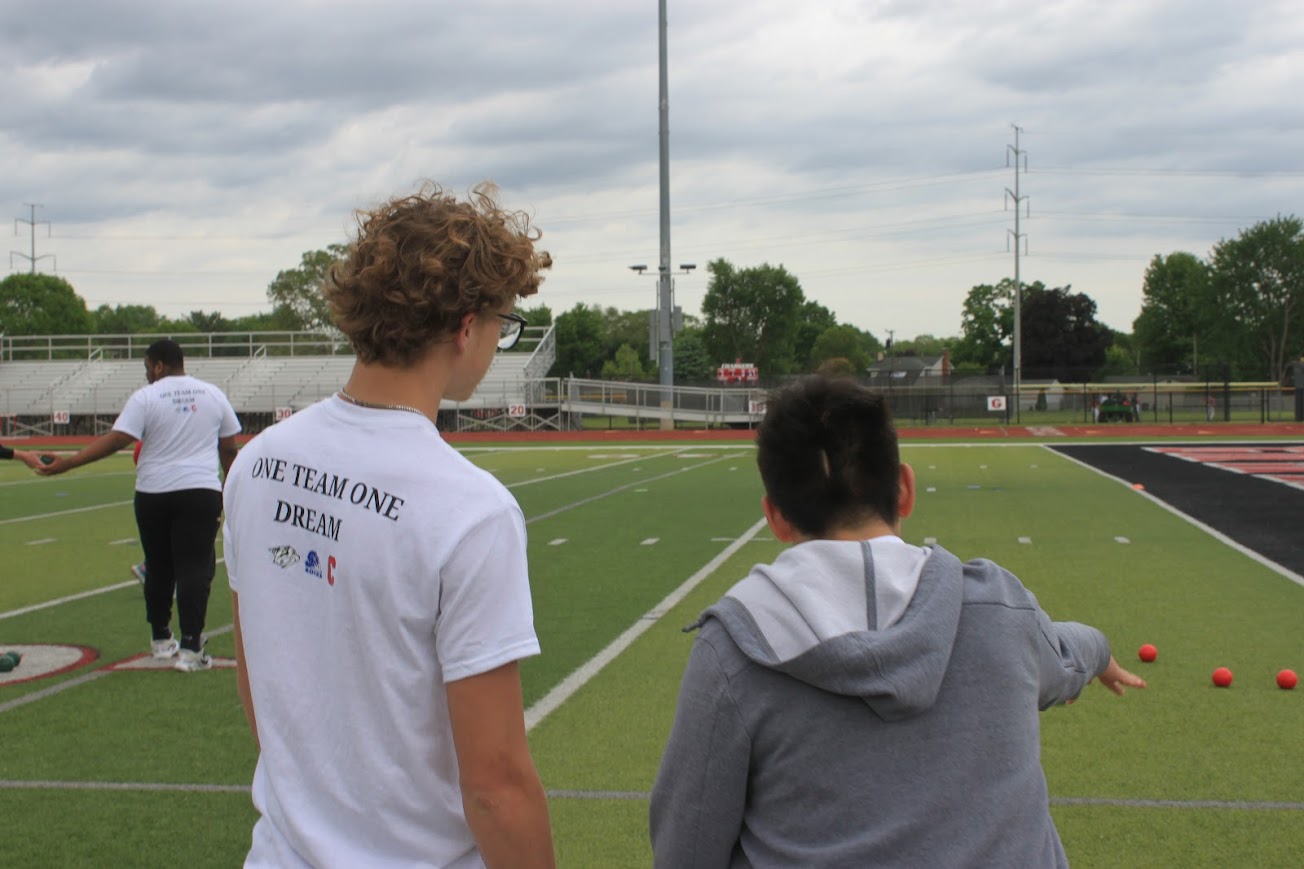

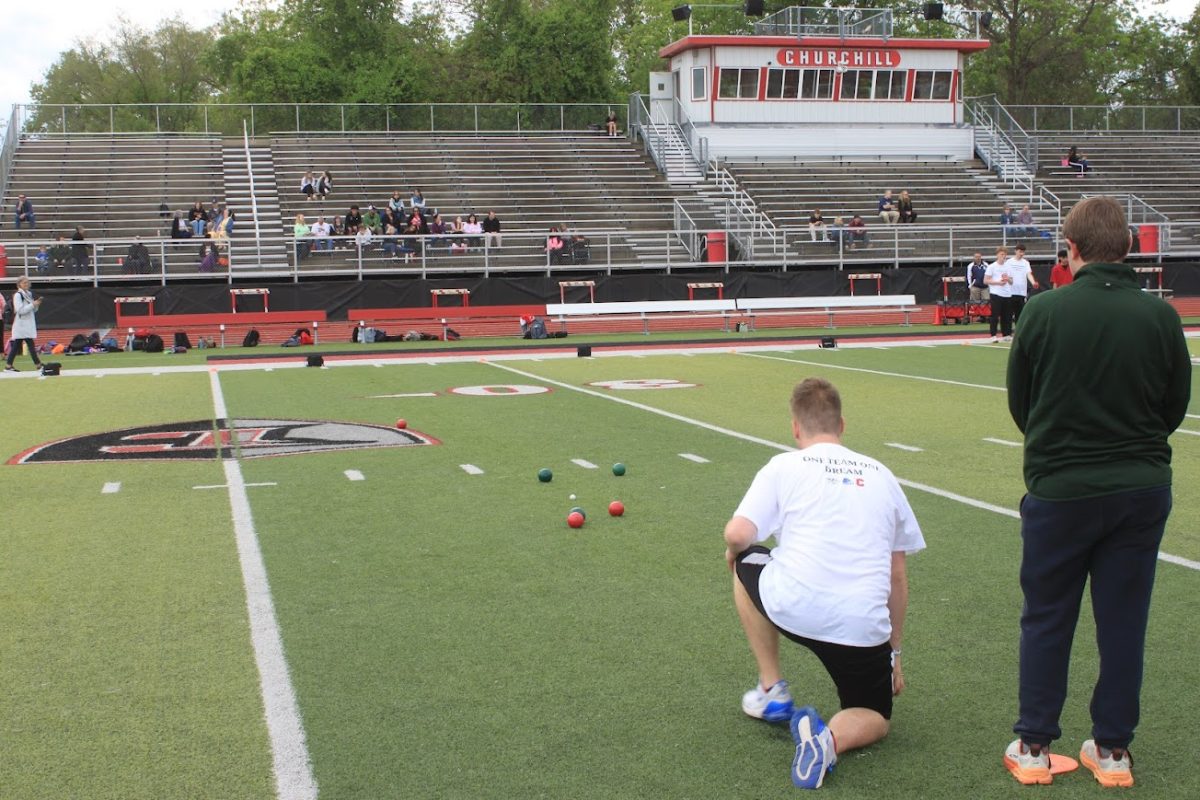
A warm spring day brings Unified Sports teams from various nearby high schools to Livonia Churchill’s outdoor track. Zachary Owens, Plymouth senior, tosses a large green ball across the football field towards a small white ball. The bocce ball rolls across the grass, stopping next to the pallino. Athletes and partners encourage one another on the field throughout the game, complimenting every throw regardless of where it lands. They don’t mention winners or losers, and spectators in the stands cheer for all athletes from the Plymouth-Canton Education Park, Churchill High School and Franklin High School.
Owens is competing in a bocce ball match where the goal of the game is to get one team’s bocce balls closer to the pallino than the opponent. The match was a part of Unified Sports, a branch of the Special Olympics that provides opportunities to high school special education students to compete in sports outside of the school day. The P-CEP Unified program includes a variety of sports throughout the school year: bowling in the fall, basketball in the winter and bocce ball in the spring. Athletes with disabilities are paired with partners who support them.
Studies have shown that participating in physical activity can affect teens’ mental health. An Aspen Institute survey of American parents found that children had reduced mental health when not playing sports. The effect can be even larger for those with disabilities. According to the survey, 38% of parents of children with disabilities reported a somewhat or great decrease in the mental health of their children when they did not regularly participate in sports. In comparison, only 24% of parents of those without disability found a large decrease in the mental health of their children when not regularly participating in sports.
A report by Daniel Lidstone found that teenagers with some combination of autism and intellectual disability are less likely to take part in regular physical activity than teenagers without those conditions. The 2021-2023 National Survey of Children’s Health, used as the data in Daniel E. Lidstone’s “Disparities in physical activity and sports participation among transition-age youth with autism and intellectual disability,” found that an average of approximately 32% of youths ages 14-17 with autism spectrum disorder (ASD) or intellectual disability (ID) engaged in no physical activity; in comparison, 17% of those without ASD or ID engaged in no physical activity. In regards to organized sports, in the study only 23% of teenagers with disabilities participated in them on a weekly basis while more than half of teens without ASD or ID did so.
Percent of Kids who participated in no physical activity on a weekly basis by Graham Murphy
According to the Lidstone report, “[The] disparities in physical activity and sport participation among transition-age youth with ASD and/or ID are a major public health concern placing this population at elevated risk for adverse health outcomes in adulthood.”
Unified Sports helps address the problem of limited participation in sports for those with disabilities. The coaches and partners work to adapt the games they play to the needs of the players. This helps provide opportunities for friendships and success in extracurricular activities.
Merrill DeRose is an adaptive physical education teacher and Unified Sports coach who has been in the P-CCS district for 16 years. She has been involved in Unified Sports since 2014 and strongly encourages participation of P-CEP students.
Participation in Unified Sports helps to promote teamwork and cooperation. “The goal of Unified Sports is to provide peer-peer sports opportunities. [Unified Sports] is an opportunity for student athletes to be a part of some level of competition while also engaging in relationships with peers and knowing what it feels like to gain confidence and succeed,” said DeRose.
Newfound confidence is partly found through learning to do something hard that may be completely unfamiliar. P-CEP paraprofessional Wendy Fong works with students in the classroom with P-CEP’s cognitively impaired program and also helps with Unified Sports. She sees how new experiences often come with new adversity of many kinds. Whether that’s sports or life troubles, Fong believes that Unified helps students deal with these challenges in a healthy way. She says learning to deal with difficult things is a good life lesson for all teens.
Fong has witnessed a positive and optimistic attitude being fostered in the kids through participation in Unified Sports. “A lot of people say, ‘I can’t hold a bowling ball.’ Well, there’s adaptive for every sport, [like at] a bowling alley where they bring out the [bowling ball ramp], and you can push [the ball], you can put the bumpers up, and then they see that they can do it,” said Fong. “And then it becomes less about how well they’re doing. It’s just how much fun they’re having.”
Students building confidence is also shown in peer-to-peer connection off the field. Plymouth sophomore Ava Kazan has participated in Unified bocce ball for both of her years in high school and enjoys the relationships with athletes she might not typically have. “We just become somebody that they can go to with questions,” said Kazen. “Or [when] they’re excited to see us in the hallway, then they can come up and talk to us.”
Canton junior Devyn Reiger has participated in Unified Sports since her freshman year and sees the positive effect it has on both herself and others. Reiger finds that she and the athletes learn skills like leadership, teamwork and communication more effectively than in a classroom.
Reiger also finds that Unified Sports brings a new perspective. “I think [participating in Unified Sports] helps me later in life because it shows a different outlook. How different people, their brains work differently, and so how I can interact with different types of people, and how I can communicate with them,” Reiger said.
Fong also says that Unified Sports is important for developing compassion for other people. She finds that after joining, students have more empathy about things as simple as when someone else is having a bad day. They are more likely to consider the difficulties of someone else’s life, according to Fong.
Active student engagement is the backbone of Unified Sports, and P-CEP paraprofessional Jennifer Farwell says students get a lot of benefits by participating. Farwell emphasizes the positive return she personally gets out of being with Unified Sports and loves seeing the joy of the students she works with. “Being together with the peers and our athletes, just their faces, they get so excited every, every time.”