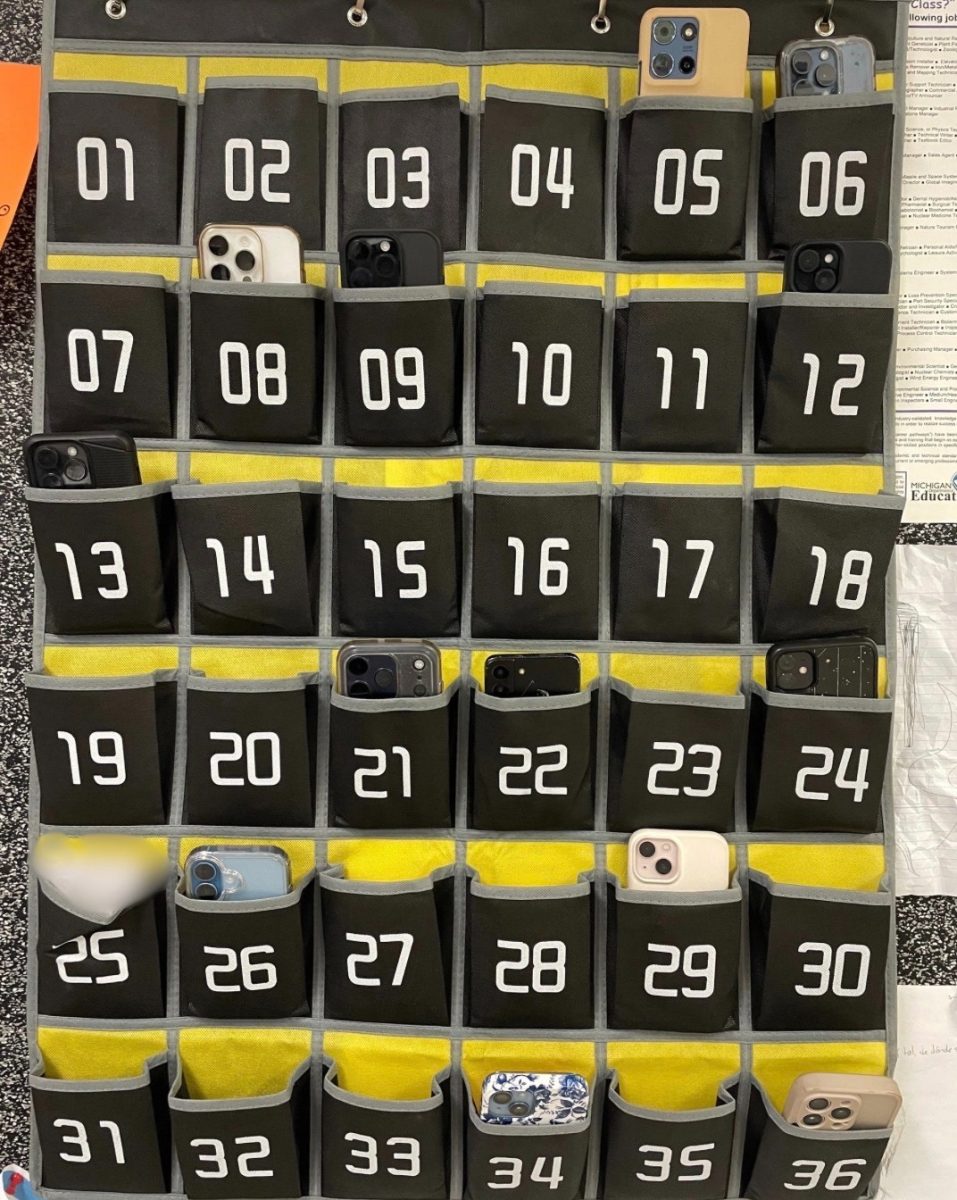
As a new semester began in January, Canton High School implemented a new phone policy with the intention to give students an opportunity to learn with fewer distractions sitting in their pockets.
Whether it’s a bin, phone wall or cubby, students are required to place their phones inside a designated spot within every Canton classroom during instructional time.
The new policy states that students are not permitted to get their phones out until the end of class. For flexibility, teachers retain the right to allow students to use phones during class for educational purposes.
The policy comes after a two-year-long study conducted by Canton principal David Reed-Nordwall and a group of ten teachers and administrators on the impacts of phone use in the school setting.
The main purpose for instituting the phone rule at Canton is to lessen risks to mental health. Reed-Nordwall aims to ensure students can improve academic performance by 10-20% by reducing cell phone usage during class.
“The studies are currently starting to find that your anxiety drops, your distractibility drops, your impulsivity drops, and your ability to pay attention increases, and [students] just doing better on tests,” Reed-Nordwall said.
Participating Canton staff read “The Anxious Generation,” a book that examines the decline in mental health of students due to the shift from an interactive, playful childhood to one filled with screens, phones, or a change that is said to have had detrimental impacts on the lives of children and adolescents. The goal of Jonathan Haidt’s book was to measure mental health rates of those using cell phones in schools. The numbers found by Haidt in the research have many in the educational field concerned.
“And so just some numbers that are really quite, I would say, motivating for us to do something,” said Reed-Nordwall. “We did the study, it became clear to us that there is an impact.”
Governor Whitmer signed a law on Feb. 10 requiring schools to put a policy in place to restrict phone usage during instructional time on school grounds which will go into effect at the start of the 2026-27 school year. Canton High School put the requirement into place one semester earlier than the state of Michigan.
Some students admit that the new restriction may be helpful in the school setting.
“You got to be able to be conscious and realize that you can’t just be on your phone, you’ve got to be paying attention,” said Canton senior Colton Hoffman. “You got to take some initiative as a student to want to learn.”
While the school instituted the new policy, teachers ultimately decide how to implement the guidelines in their classroom.
Erin Le and Charles Hameline are two Canton teachers who participated in the group study with Reed-Nordwall.
Social studies teacher Le never had a strict cell phone policy in her classroom before the rule was implemented. She simply had students leave their phones in their backpacks where they couldn’t be seen.
“Sometimes it would just stay on the desk, sometimes it would just, you know, come out when they had work time or something like that,” said Le. “And so I don’t think it was a successful policy prior.”
However, some teachers like science teacher Hameline already had their own cell phone policies in their classroom.
“This [numbered phone caddy] has been up in my classroom for about four years, and when I first started using it, it was just during testing, quizzes,” Hameline said. “But then I gradually increased it to be pretty much all day, every day.”
Reed-Nordwall plans to get together with his team regularly to determine the next steps the committee should take with the phone policy based on observations and feedback.