

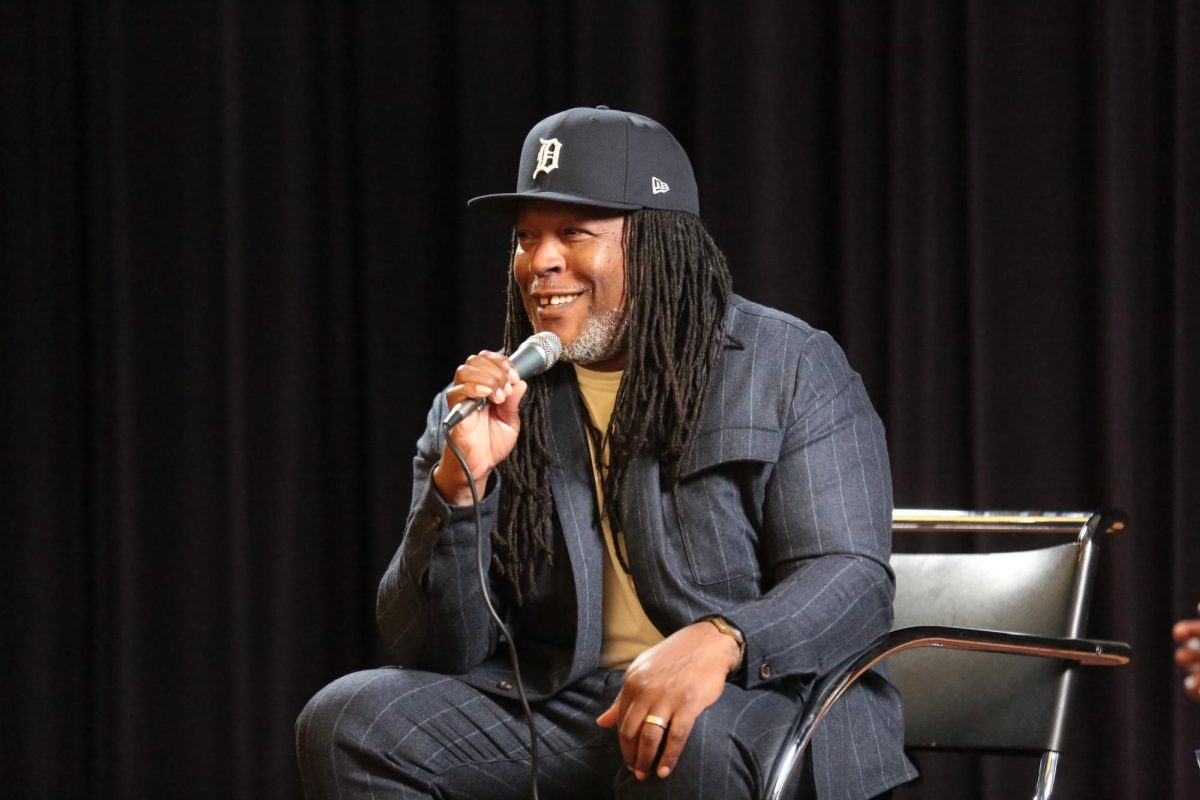
Shadowing Shaka Senghor for part of his hometown book tour stop in the city didn’t feel like the average media junket. Every space we entered carried its own emotional gravity. People were not there simply to hear about a book. They came carrying questions about grief, freedom, and how to live with the weight of what they had survived.
Shaka Senghor is an African American bestselling author and public speaker from Detroit. He advocates for criminal justice reform and has been recognized by Oprah Winfrey’s SuperSoul 100, Ebony Magazine’s Power 100, and the NAACP’s Great Expectations Award. Recently, the Shaka Senghor Literary Lounge opened in his name within the Michigan Central Station, which serves as the newest participating location of the Boys and Girls Clubs of Southeastern Michigan.
Senghor was also convicted of second-degree murder at 19 years old, serving 19 years in prison, seven of which he spent in solitary confinement.
Senghor has published three books since his release in 2010. His most recent work, “How to Be Free: A Proven Guide to Escaping Life’s Hidden Prisons,” is a self-help memoir offering a roadmap for overcoming mental and emotional barriers based on lessons learned while incarcerated.
Because Senghor is a family friend, I experienced the book tour stop in Detroit from a vantage point few people have. I was present not only for the public moments onstage, but also for the quieter ones in between. The pauses before entering a room. The conversations that lingered long after events officially ended. What struck me most was the care with which he carried the work. Nothing felt rushed or performative.

Much of the foundation for Senghor’s most recent novel came from letters he received during the COVID-19 pandemic. Seeing as he navigated years of solitary confinement, people wrote to him looking for guidance on how to navigate isolation, uncertainty, and the emotional toll of being cut off from one another. Those letters helped shape the book’s urgency and its focus on internal freedom as a daily practice. They reminded him how many people were struggling quietly and how necessary it was to speak honestly about what freedom actually requires.
Senghor began “How to Be Free” by writing about the death of his brother Sherrod, who was murdered in 2021. He said that naming that loss at the outset of the writing process forced him to confront grief without detour. It required him to acknowledge the complexity of mourning when accountability and harm are part of the same story.
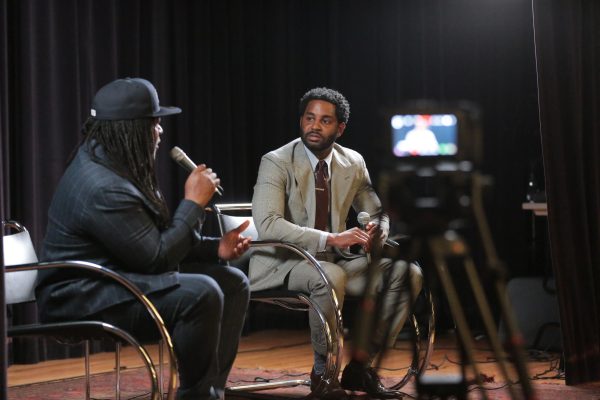
During a Q&A session called “ShopTalk” held at the main branch of the Detroit Public Library and hosted by the CEO of The Social Club, Sebastion Jackson, Senghor reflected on the moment he realized that his own past actions had once caused another family to experience a similar tragedy. That recognition reshaped how he understood grief and how he allowed himself to sit with it.
“Grief is the most complex hidden prison,” he said during one conversation. “All loss isn’t created equal.”
What stayed with me was not just the honesty of that admission, but the discipline behind it. While writing, Senghor made a rule for himself. He would only tell the truth. “I was able to lay out all the trauma,” he said, “but I was also able to see all the beauty.” That commitment to truth, both painful and redemptive, became the backbone of the book and of the tour itself.
Onstage, Senghor resisted offering easy inspiration. He asked audiences to sit with complexity instead. He spoke about consistency and about how the choices we repeat shape the lives we lead. “You don’t get resilience by winning one battle,” he reminded people. Growth, he emphasized, is cumulative. It is built slowly through daily decisions that often go unnoticed.
His audience responded to that honesty. Senghor never underestimated his listeners’ ability to hold nuance. He spoke openly about shame and how it prevents people from feeling worthy of change. He drew a clear distinction between guilt and accountability, emphasizing that freedom begins internally before it can ever become external. “Freedom is an inside job,” he said. “You have to be honest with yourself and ask, ‘Am I choosing to suffer?’”
During his leg of the tour at the University of Michigan for the Prison Creative Arts Project’s Prison Atonement class, an initiative he helped found during his fellowship with the MIT Media Lab, he spoke directly about the systems within incarceration, particularly education and mental health.
Senghor noted that the average reading level in prison is about the third grade. This intellectual barrier is exacerbated by a lack of access to books. While inmates crave engaging and relatable material to bridge their educational gaps, those works are routinely banned. His own first two books were no exception.
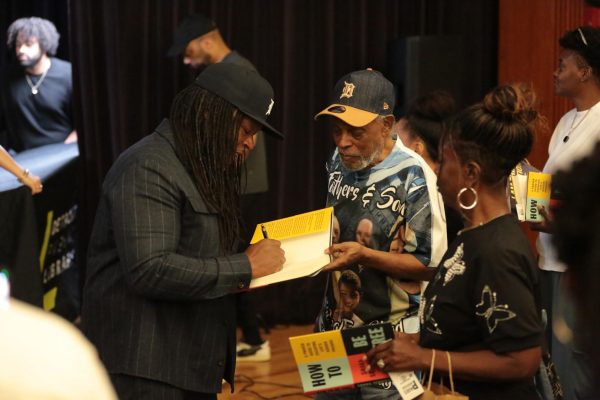
In response, Senghor donated “How to Be Free” to over 1,300 prisons through a platform called Edovo, a decision that allowed the work to reach nearly a million incarcerated readers.
Senghor spoke about how poorly prisons are equipped to address the mental health of prisoners, describing the lack of care as a “humanitarian failure.” He talked about “incarcerated PTSD,” about finally going to therapy himself, and about how adaptability is often mistaken for strength. In reality, he explained, adaptability is sometimes just survival learned through prolonged hardship.
Grounding all of these conversations was Detroit itself. Senghor spoke about growing up with a deep love for the city, its endurance, and its humanity. He spoke about focusing his advocacy not only on policy, but on the human cost of neglect. Reform, he reminded me, is never abstract to those who know the people living inside its failures.
By the end of the tour, I understood that shadowing Shaka Senghor was not simply about observing a public figure at work. The experience allowed me to witness first-hand what integrity looks like in motion, and it looks like consistency. It looks like care. Most of all, it looks like a refusal to reduce complex lives into simple narratives.










Tee • Mar 3, 2026 at 9:33 am
Great article! This was an extremely insightful piece.
Harlan • Feb 13, 2026 at 6:12 pm
Thanks for the glimpse into his life and experiances.
Clement Brown, Jr • Feb 13, 2026 at 4:28 pm
Beautiful written.
Well informed and very insightful.
ms Evans • Feb 13, 2026 at 4:28 pm
Amazing !!!