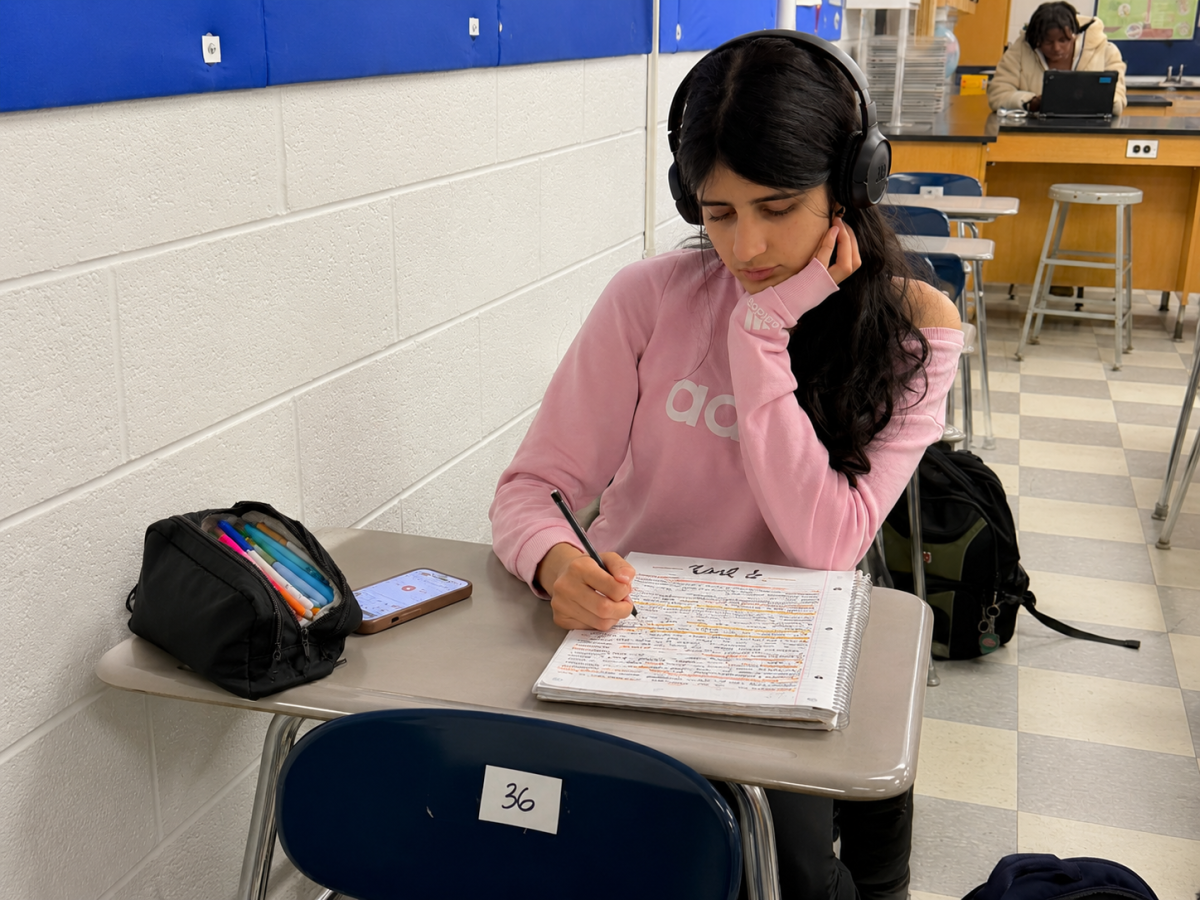
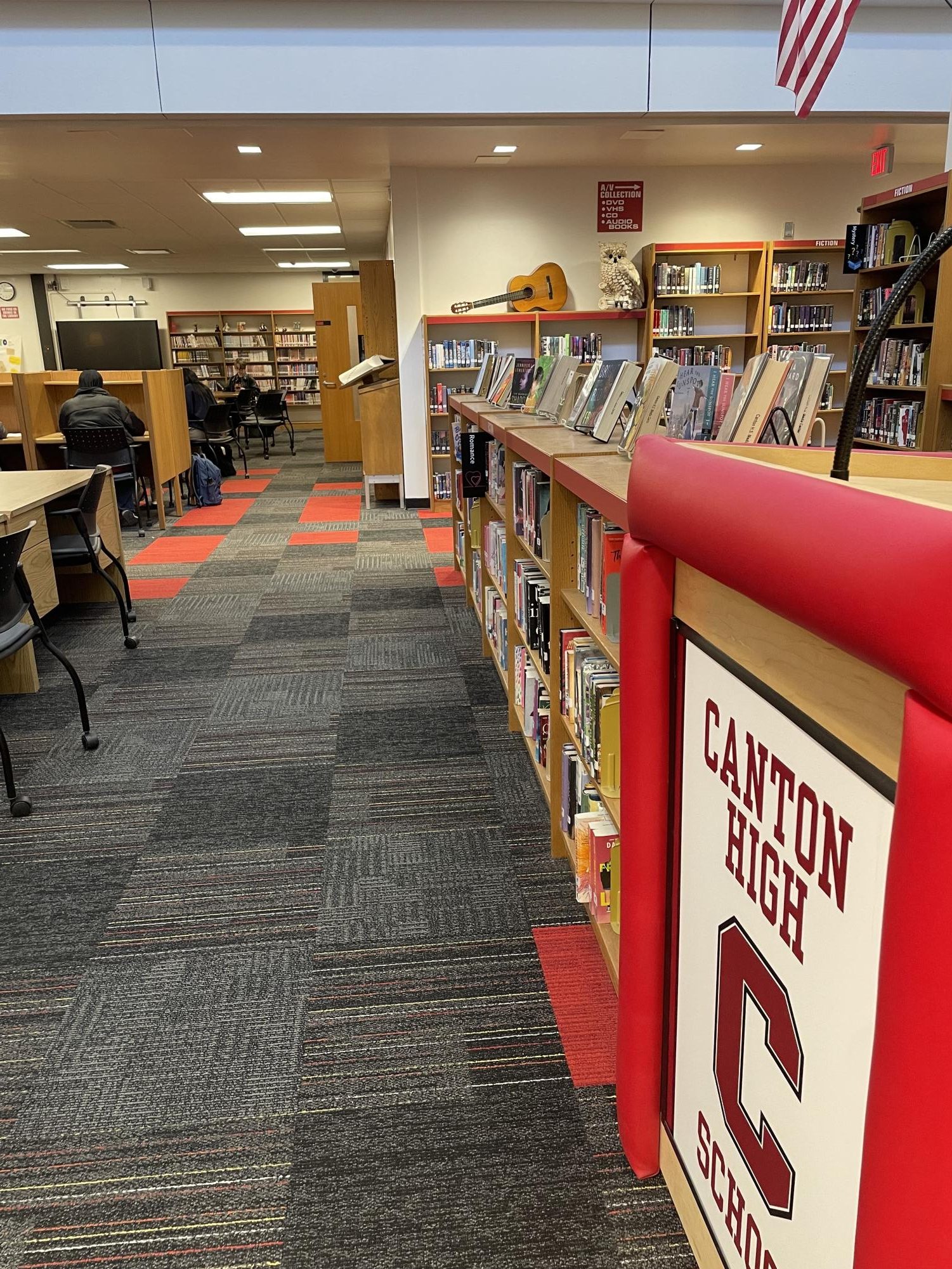
It was not quiet in the library. On this chilly Saturday afternoon with snowflakes falling in the windows only to melt on the pavement, one could be forgiven for thinking there were more people than books in the Canton Public Library. Teens in hoodies and varsity jackets (a few of them from Salem) crowded every private nook or plush chair, studying for their upcoming finals.
Canton Public Library serves over 98,000 people, so this isn’t terribly surprising, but the fact that many had forsaken books for laptops and iPhones somewhat was. It’s just another small detail in what some claim is a growing teen literacy crisis that has developed over the last decade.
First, it should be acknowledged that moral panics over a supposed teenage literacy crisis are nothing new. In 1979, literary scholar Martha Maxwell wrote, “Every generation, at some point, discovers that students cannot read as well as they would like or as well as professors expect.”
But neither are such fears completely unwarranted. Rose Horowitch, in her Atlantic article “The Elite College Students Who Can’t Read Books” notes how many college professors have had to shift their curriculum around their students’ declining ability to complete assigned readings. A 2024 government report by the National Center for Education Statistics shows that reading scores across the nation have been on a slight but steady decline for at least a decade, if not longer, with a growing number of 12th-grade students unable to meet even the basic standard for literary comprehension. Test scores aren’t everything, but even a 2022 Scholastic report would seem to confirm the story, highlighting decreased rates of regular reading contrasted with increased screen time and declining mental health in kids 6 to 17 years old after the COVID-19 pandemic.
Samah Suliman, Plymouth senior and president of the Park’s book club, Fantastic Books and Where to Find Them, agrees with the concern. “I do think there is a lot of merit to the idea of a literacy crisis. I do think the lowered expectations of English language arts classes are real. And I do think that literature is a really, really important thing.”
Fantastic Books is a student-run club. Students pick the book they read, and their discussion afterwards ranges from the personal history of authors like Oscar Wilde to modern celebrity and beauty culture to the casting of Disney princesses.
Suliman tries to cultivate a relaxed, informal atmosphere where students can freely talk about what they find interesting in the books without adhering to strict literary analysis, which has helped make the 2025-2026 school year the largest year yet for the club. However, that still only means 18 regular members out of a student body of over 6,000, some of whom join for the discussion but don’t finish or sometimes even pick up the book.
Andrea Wright, Canton English teacher, says kids not reading the book doesn’t surprise her. While every year she gets a few students who love literature, she’s noticed a decline in how often students are reading, especially with the rise of artificial intelligence. According to Wright, “I can take ‘The Odyssey’ and relate it to real life right now, but I feel like, because I’m forcing it, they give kind of a push back, because it’s not their decision.”
Salem counselor Matthew Shepherd is familiar with that struggle from his time as a biology teacher. “I felt like, as a teacher, I would lose a subset of kids every time I made a reading-based biology lesson,” he says, “and even if I managed to sell it, I could see kids still trying to shortcut, like they see the paragraph they’re supposed to read, and they’re barely engaging with it and trying to just skim for the answers.”
It’s not just the fear that students are losing the ability to read a textbook. “I think reading is the closest way you can read someone’s mind and be in their head,” says Suliman. “I like that. And so I think that’s what really is the power of fiction, especially to feel that and see that. I think it really teaches empathy, and I wish that was emphasized a little bit more in terms of what I think teachers can do.”
But Suliman isn’t too worried about a teenage literacy crisis. “People are still reading. They just do it in different ways than they used to,” she says, pointing to how the internet has allowed new forms of literacy to take hold, from fan fiction to Wikipedia research.
That is a sentiment Lisa Boyd can get behind. She’s an information services librarian at the Canton Public Library, and the person responsible for acquiring all the teen media in the Library. According to Boyd, “I think that maybe what we’re focusing on is the wrong thing. And I think that teens are still reading, but what they’re reading is different from what we think they’re reading.”
Much of Boyd’s work has her trying to meet teens where they are. After the COVID-19 pandemic, much of her budget has been spent on digital materials or other more accessible media for those with disabilities that impact reading or other complications. As for print, manga and light novels have become a crowd favorite in recent years, making them a focus for Boyd when selecting new media for the library.
In Boyd’s view, the way to get more people into reading is just a question of community, saying, “I really think understanding what people in your area are into is a big part of it. So really, when you talk about meeting people where they are, you have to know those people and not just make generalizations, and you have to also know that there’s no majority, that you’ve got a lot of different kinds of people.”
Boyd looks at statistics to judge what books are most in demand, but in her experience, a little human touch goes a long way. “Regardless of budget, it doesn’t take a lot to try and do a little bit, talk and be around for those people,” she says.
For her part, Wright has been an advocate for choice reading in her classroom, along with efforts to modernize the curriculum. Wright hopes that by embracing the changing habits of her students, she can get more students interested in reading, saying, “That’s the whole reason for pushing choice reading. If a book’s boring, they’re not going to read it. I don’t blame them.”
Librarians revamping the collection or ELA teachers encouraging choice reading and modernizing curricula aren’t necessarily eye-catching changes, and they may not get every kid interested in reading. Suliman says, “I understand at the end of the day, there’s only so much one teacher could do, especially when reading is just so de-emphasized.”
But Suliman remains hopeful. While talking about the vast selection of books available to students at the Park, from the three school libraries to the Canton Public Library and the Plymouth District Library, she shared an anecdote about one of the stranger works she found in those catalogues. “The main character speaks a very specific dialect of, I believe it’s Irish,” she says. “And so the point of the story was that even though you can’t really understand a lot of the stuff she says, the raw feeling of being in her head in this specific time period, in this specific place, can still really resonate with you.”